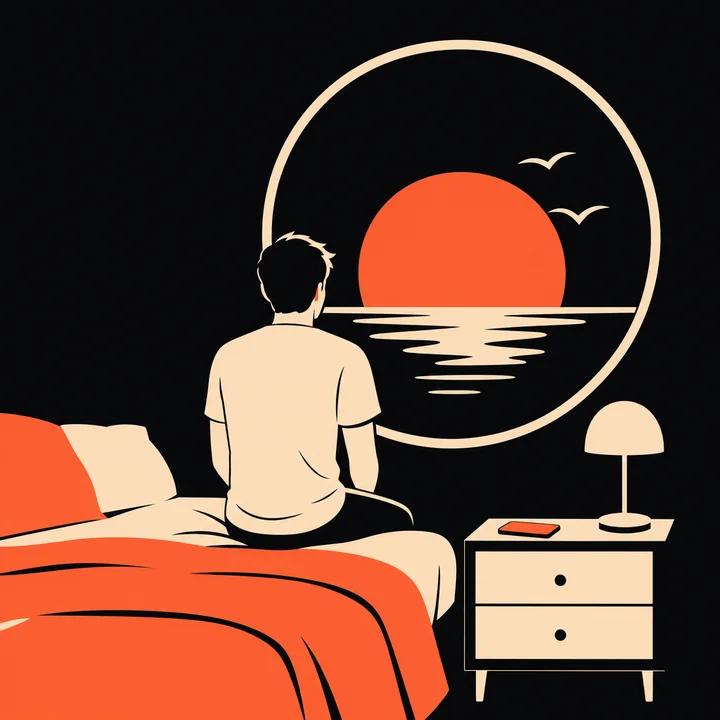
Change your environment first: block porn on every device and keep your phone out of the bedroom at night. Then list your triggers, write an if-then plan for urges, tell one person, and decide in advance what you will do after a slip. If it comes with depression, anxiety or sexual problems, see a professional.
What "porn addiction" means, and what it doesn't
"Porn addiction" is how most people describe the problem, but it is not an official diagnosis. The WHO's ICD-11 lists compulsive sexual behavior disorder (6C72) instead: a persistent pattern, typically over six months or more, of failing to control intense, repetitive sexual urges, with marked distress or problems in daily life.
The WHO placed it with impulse control disorders rather than addictions because the research isn't settled. You don't need a diagnosis to want to change, though. If you have tried to cut back and keep sliding back, that is reason enough. The porn addiction test is a private self-check, not a diagnosis.
How to stop watching porn: the plan
- Pick a clear goal and a start dateDecide what counts: no porn at all, or no porn and no masturbation for a set time. Write it down with a date. "Watch less" is easy to renegotiate at midnight.
- Block porn on every devicePhone, tablet, laptop and every browser you use. A blocker on one device just moves the habit to the next one. Our guide to blocking porn on iPhone walks through Screen Time step by step.
- Map your triggersFor one week, note when urges hit: the time, the place, the mood. Many people end up with a short list, such as late at night, alone in bed with the phone, bored, stressed or after a bad day.
- Write an if-then plan for urges"If I'm in bed and the urge starts, then I put the phone in the kitchen and read." A concrete plan made in advance beats willpower in the moment.
- Protect the late-night windowCharge your phone outside the bedroom and set a fixed time for screens off. Tired, alone and online is the classic setup for a relapse.
- Tell one personA friend, partner, sibling, mentor or support group. You don't have to share details. Someone who knows makes the habit harder to hide.
- Add a commitmentSomething you would rather not lose: a promise to someone you respect, a commitment contract, or money on the line.
- Decide now what a slip meansA slip shows you where the plan was thin. It is not proof that you can't change. Write down what happened and go back to the plan the same day.
Make porn hard to reach, not just hard to want
Habits run on cues. In one study, students who moved to a new university kept habits like exercising or watching TV only when the context stayed the same. When the cues changed, the old habit broke and people acted on their intentions instead. You can change the cues on purpose.
- Block adult sites at the device level, not in one browser. Private tabs and a second browser are the usual way around a single-browser filter.
- Remember the apps. Social feeds and some forums carry explicit content too. If a feed is where it usually starts, block or delete it for now.
- Move the phone. If the bedroom is where it happens, the phone sleeps somewhere else.
- Cover the forgotten devices: an old tablet, a work laptop, a games console with a browser.
Be honest about the limit. Every blocker has an off switch, and a strong urge at 1 a.m. will go looking for it. In a study of 104 abstinence journals on a "rebooting" forum, members described blocking apps as somewhat useful, while social support and accountability were what mattered most. Blockers buy you time. People and plans do the rest.
Know your triggers
Triggers come in two kinds. External ones are places, times and content: the bed, the shower, an empty house, a suggestive post in your feed. Internal ones are feelings: stress, boredom, loneliness, anxiety, rejection.
Relapse-prevention research, first developed for alcohol and drugs, links negative emotional states such as anger, anxiety, depression, frustration and boredom with the highest rate of relapse. If porn has been your way to switch off a bad feeling, that feeling will show up as a cue. Plan for it rather than hoping it won't come.
Write your top five triggers down, and next to each one what you will do instead. The free relapse prevention plan below walks you through it.
Relapse prevention planBuild your one-page plan: triggers, warning signs, if-then plans and who to call. Print it or save it as PDF.What to do when an urge hits
An urge feels as if it will keep building until you give in. It doesn't. Urges rise, peak and fade, and changing what you are doing helps you through the peak. Arguing with the thought tends to backfire: some forum members in the same study noticed that "don't think about it" kept the thought alive.
- Name it: "This is an urge. It will pass."
- Change your body state: stand up, cold water on your face, a shower, ten push-ups.
- Leave the room, and leave the phone behind.
- Walk for five minutes, outside if you can.
- Text or call someone. You don't have to say why.
- Breathe slowly: in for 4, hold for 7, out for 8, for a few rounds.
For a skill that works with the urge instead of against it, read our guide to urge surfing.
Accountability and commitment
Telling someone works partly because secrecy is part of the habit. Choose a person who won't shame you, and agree on something simple: a weekly check-in, or a text when it's hard.
Commitments help when they cost something. In a randomized trial, smokers offered a voluntary commitment contract (their own savings, forfeited if they failed a nicotine test) were 3 percentage points more likely to pass the test at six months than a control group, and the effect held in surprise tests at twelve months. Only 11 percent took the offer, so it suits people who want it, not everyone.
If you slip
Slips are common. In the forum study, more than half of the 104 journals described at least one relapse during the attempt. What you do next matters more than the slip itself.
Researchers call the spiral after a lapse the abstinence violation effect: the slip brings guilt and a sense of failure, and that feeling can make a full relapse more likely ("I've already blown it, so why not"). Break the spiral on purpose:
- Stop there. One slip doesn't have to become a lost weekend.
- Write three lines: what time it was, where you were, what you felt just before.
- Close the gap that let it through: a device, an app, a time of night.
- Restart the count today, not next Monday.
When to get professional help
Self-help is enough for many people. It isn't enough if porn use comes with depression, anxiety, thoughts of harming yourself, sexual problems with a partner, or real damage to your work, money or relationship. A therapist who works with compulsive sexual behavior can help, and so can your doctor.
Therapy has evidence behind it. In a small randomized trial, 28 men (nearly all from one religious community) who received 12 sessions of acceptance and commitment therapy cut their viewing by 93 percent, against 21 percent on the waitlist. Three months after treatment, 74 percent of all participants were still at least 70 percent below where they started. It is one small study, but it shows these skills can be learned.
If you are in crisis or thinking about suicide, call or text 988 in the US (Suicide & Crisis Lifeline), or your local emergency number.
Questions
What does a porn addiction look like?
Usually a pattern rather than one behavior: you have tried to cut back and can't, you watch for longer than you meant to, it costs you sleep or time you needed, and you keep going despite the costs. Our 10-question self-check covers the signs in detail.
How long does it take to quit porn?
There is no fixed number, and it differs a lot between people. Expect urges to fade gradually over weeks to months rather than switch off on day 30 or day 90. Our guide on how to rewire your brain covers what habit research says.
Is porn addiction a real diagnosis?
Not under that name. ICD-11 lists compulsive sexual behavior disorder (6C72): a persistent loss of control over sexual urges and behavior with marked distress or impairment. Only a clinician can diagnose it; an online test can't.
Can I quit porn without a blocker?
Yes, people do. A blocker only removes the easiest path at your weakest moments. If you skip it, lean harder on the rest: the phone out of the bedroom, an urge plan and someone you check in with.
Do I have to stop masturbating too?
That is your call. Masturbation is normal and healthy for most people. Some find a break helps them separate it from porn; others find a total ban builds pressure. See how to stop masturbating if that is your goal.
What should I do after a relapse?
Stop, note what led up to it, close the gap that let it through and restart the same day. Guilt can make the next slip more likely, so treat the slip as information about your plan, not a verdict on you.
Related guides
- How to block porn on iPhone and iPad, and keep it blockedBlock porn on iPhone and iPad with Screen Time, SafeSearch and a DNS filter: steps for iOS 18, 26 and 27, the gaps people slip through, and how to close them.
- Relapse prevention plan: what goes in it, a filled-in example and a free templateHow to write a relapse prevention plan for porn, gambling or scrolling: what goes in it, a filled-in example, the 5 D's and a free printable template.
- Urge surfing: how to ride out a craving, step by stepUrge surfing is a mindfulness skill from relapse prevention: you watch a craving rise, peak and fall without acting on it. Its origins, evidence and a script.
- Signs of porn addiction: 10 questions to ask yourselfPorn addiction symptoms explained without shame: 10 honest questions, what the ICD-11 diagnosis covers, what research links to problem use, and what to do next.
Sources
- Kraus et al. (2018), Compulsive sexual behaviour disorder in the ICD-11, World Psychiatry
- Wood, Tam & Witt (2005), Changing circumstances, disrupting habits, J Pers Soc Psychol
- Fernandez, Kuss & Griffiths (2021), The pornography "rebooting" experience, Archives of Sexual Behavior
- Larimer, Palmer & Marlatt (1999), Relapse prevention: an overview of Marlatt's cognitive-behavioral model
- Giné, Karlan & Zinman (2010), A commitment contract for smoking cessation, AEJ: Applied Economics
- Crosby & Twohig (2016), Acceptance and commitment therapy for problematic internet pornography use, Behavior Therapy
General information, not medical or psychological advice. If you’re struggling, talk to a doctor, a therapist or one of the helplines on our responsible use page.